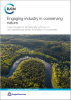
Engaging industry in conserving nature
With 26 case studies from 10 multinational companies, this publication highlights their positive actions, interventions and initiatives contributing to specific conservation and restoration goals.
Nature (covering the water, biodiversity, soil/land, and air/climate realms) continues to decline with significant negative impacts on society. Businesses need to understand their impacts and dependencies on nature, manage their nature-related risks and embed the value of nature into their decision making to identify and implement opportunities that contribute towards the nature-positive global goal.
The coaching manual (COMIT) is for the second version of the Integrated Management Effectiveness Tool (IMET) and of coaching or professional support for protected area management teams. IMET is a decision-support tool intended to develop the planning-monitoring-evaluation process in order to improve protected area management effectiveness. It is suitable for all protected areas, regardless of their management and governance category.
In this paper, the authors attempt to value the biodiversity functions of India's natural ecosystems and suggest a method to adjust national (GDP) and state income (GSDP) accounts.
There has been much concern over the world’s catastrophic failure to meet global targets set in 2010 to save biodiversity. Birds and Biodiversity Targets uses BirdLife’s extensive worldwide research to provide a road map to ensure the 2020s are not just another “lost decade for nature”.
Dans cette publication, nous faisons le point sur les connaissances et le savoir-faire générés par la première étape du projet, consistant à évaluer les principales menaces qui pèsent sur la biodiversité et à fournir des éléments de réponse aux questions spécifiques suivantes : comment les principales menaces pour la biodiversité ont-elles été identifiées et hiérarchisées, et comment les secteurs associés ont-ils été sélectionnés dans chaque pays ?
The circular economy is a positive step forward to help achieve our environmental targets. When implemented with nature in mind, it can present an important opportunity for nature and biodiversity. As outlined by the Intergovernmental Science-Policy Platform on Biodiversity and Ecosystem Services, to halt and reverse biodiversity loss by 2030 we will need to transform our production and consumption systems.
In this publication, we take stock of the knowledge and know-how induced by the BIODEV2030 project’s first step, which is to assess the main threats to biodiversity and provide elements to address the following specific questions: how were main threats to biodiversity identified and ranked and associated sectors selected in each country? Were the different methods converging in identifying top threats?
Com base no volume de rejeitos lançados e na extensão das áreas atingidas, o rompimento da Barragem de Fundão, em Mariana, Minas Gerais, foi o maior desastre ambiental de todos os tempos na mineração brasileira, e um dos mais graves do mundo. Ao serem transportados a jusante da barragem rompida, os rejeitos foram se acumulando ao longo dos rios e alcançaram o estuário do Rio Doce, na ecorregião marinha do Leste brasileiro, afetando importantes ecossistemas.
Based on the volume of tailings releases and the distance they travelled, the Fundão Dam failure in southeast Brazil (Mariana, Minas Gerais state) was the largest ever environmental disaster in Brazil’s mining industry, and one of the world’s most serious. As they dispersed downriver, the tailings accumulated along the riverbanks and reached the Rio Doce estuary in the Eastern Brazilian Marine Ecoregion.